


Normalising a behaviour that doesn’t exist
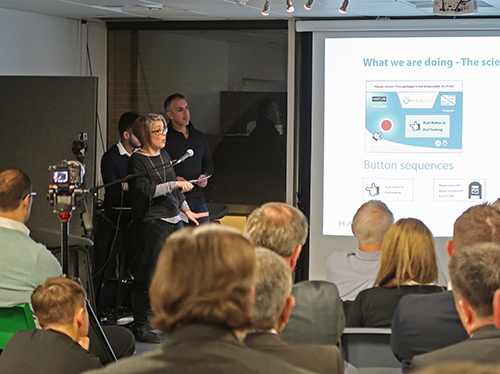
Over the past few weeks consumer behaviour specialist Charlotte Beckett has been working with Hanhaa on a project very unique to ParceLive – ensuring that devices are returned after reuse. Hanhaa has made this process as easy as possible by negating the need for stamps or packaging during the return logistics phase and has now set about educating users on the ease of this behaviour. Charlotte first presented her work at the ParceLive Open Forum on 30th January and this piece illustrates in more detail the steps that Hanhaa are taking to ensure that as many ParceLive devices as possible are returned by the end user.
30th January 2017
Be it the latest blockbuster, a widget for something DIY important or a case of wine, we all know the feeling of waiting for parcels to arrive. Then they do. We tear them open, sift through for our stuff, and then chuck the packaging in the re-cycling. Or re-seal it ready for a return. Apart from what we’ve bought, there’s nothing else in there of worth that needs our attention. Only you, committed to our customer experience, have included a Parcelive tracker. We weren’t expecting it, we’re not primed to look for it, let alone do something with it. How do can we be nudged into action?
First Impressions Do Count
Brands have seconds to make a good impression. We make quick judgements based on “thin slices” of experience and minimal amounts of information. (1) And a third of consumer decision-making is based on packaging, up to 90% of that from the front (2). As consumers, we want quick, effortless decisions, and find simple rules and tactics to make our choices. 80% of perceived information is non-verbal and this form of information is processed quickly and easily (3). Little effort is spent on cognitive processes like reading and comparing prices (4). We make judgements from what we see, using visual cues – package size, shape, materials, graphics, fonts, colours – to guide. No single cue works in a vacuum: we make our decisions based on all we have available, known as Cue Utilisation Theory (5). Without sufficient information from these cues we create our own narrative. As an example, in early trials, one participant returned their Parcelive unit in an envelope. They had picked up the cue to return but rather than process that it was free post, defaulted to habit. Too much and we have decision paralysis. Brands, and designers, need to strike a balance.
We Instinctively Know Where To Look
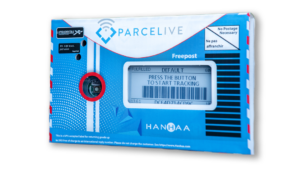
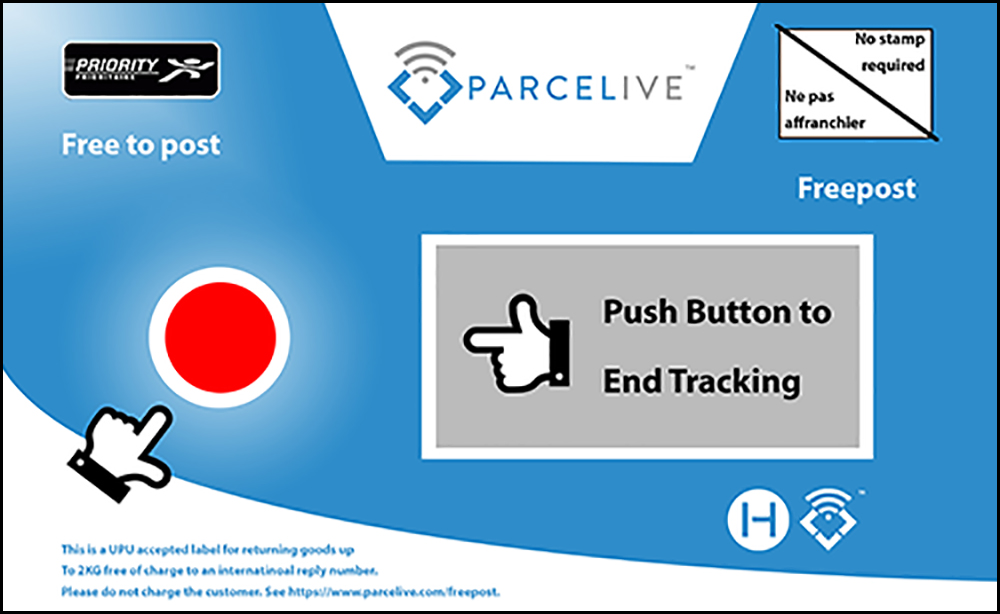
To help absorb information, we use “scan paths”, (6) which are often learned patterns. These can be deeply ingrained. We scan the text on a web page as we do on the printed: starting at the top left hand corner and fanning out in an F shape (7). We’ve learnt that certain information will be in a certain place, such as the prices under the products on supermarket shelves. And postage stamps are always top right. The official free post icon on our Parcelive packaging is a text based graphic, rather than a colourful stamp. To avoid interpretation as the space to affix a stamp, and to re-iterate that returning the unit costs the individual nothing, we have enlarged the icon and added the words “free post” clearly close by:
When The Eye Stops, The Action Begins
Colour attracts our attention both involuntarily (through unfamiliar cues, such as Pepsi’s use of blue in a category dominated by red) and voluntarily (through cues stored in our memory, triggering emotions – our preference for a particular colour – or cognitive responses: clear associations). (8)
Whilst different colours have different meanings, depending on the culture, red has a universal association with “stop”, “urgency”, “action” (9). By making the button to turn off the tracker red, we’re triggering a voluntary, cognitive response. Whilst the actual colour can be less important than its brightness, the best converting online buttons are red against other colours (green, blue) showing an uplift in conversions by up to 34% (10)
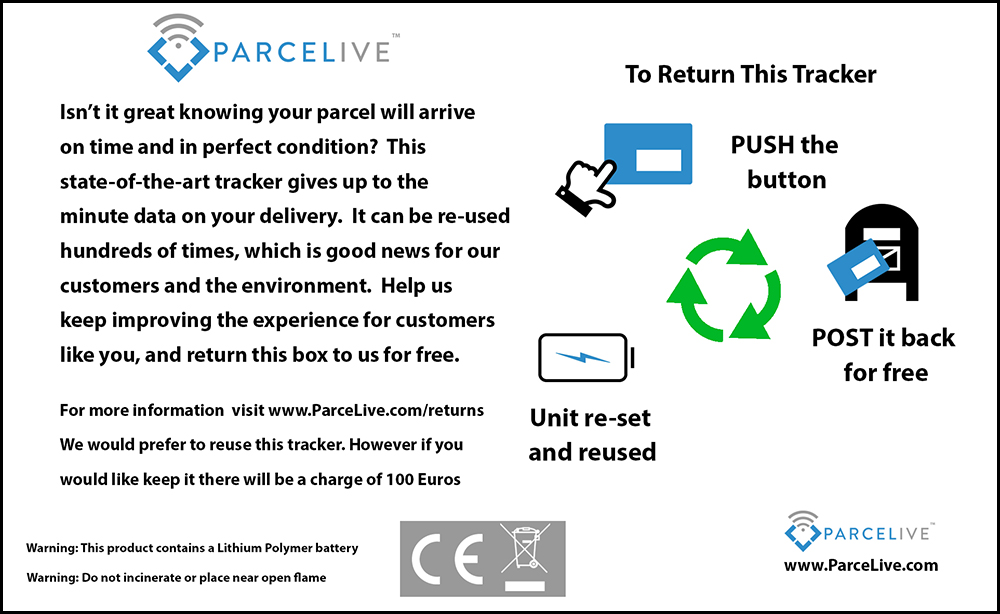
The Parcelive unit will be fixed to the side of the packing, and likely viewed from above as the package is opened. To stop people in their tracks and hold their attention, we’ve included a warning in red along the thin edges of the unit. We’ve used both text and icons in the on-screen and back of pack instructions, making it simple to understand the return process if you are scanning the box quickly or, indeed, if English is not your first language. On the reverse of the box, we’ve used a green circle of arrows to further suggest a circular process to re-use the unit (green is associated with the environment and recycling)
What Stands Out Gets Remembered
And what blends in gets ignored (the Isolation Effect (11). Good design makes use of negative space, splitting visual elements into foreground and background. It uses the negative space – most often white – as if it were a solid visual element in the design. Where this space occurs, its shape, and what it affects becomes of paramount importance in leading the viewer to the intended result. For this reason we’ve included a white border around both the button and the screen, and white on the reverse of the box, to further draw the eye in where we want it. In addition, a slightly over large hole shows some of the tech inside the box, to subtly confirm that this is something of worth, not something to throw away.
But There’s More Than Meets The Eye
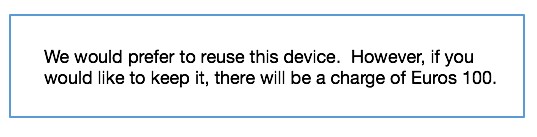
How we buy, use and dispose of products, is not just based on what we see. We also look for linguistic signs and respond to aural cues (12). On the back of the box we’ve used various linguistic cues to nudge behaviour. Inclusive language, that addresses us directly, suggests that we’re part of a tribe. (13) If we identify with whoever’s speaking to us, we are more likely to comply with a request. Phrases such as “customers like you” further re-inforce this: returning the box is the accepted behaviour of the tribe. We are more productive – make more effort – when our actions have meaning (14). Our text, therefore, opens with a “what’s in it for me” statement, followed by an explanation of what’s inside the box. Finally, we give clarity that returning it means it will be re-used, benefiting “people like me” as well as wider society. Using open, friendly language adds a “pleasure layer” to what otherwise would be a functional list of information and instructions (15). We’re building an emotional response: to be socially accepted, I need to return the box, I will personally benefit if I do, and I want to because this brand understands and values my needs as a customer.
If All Else Fails, What If We Impose A Penalty
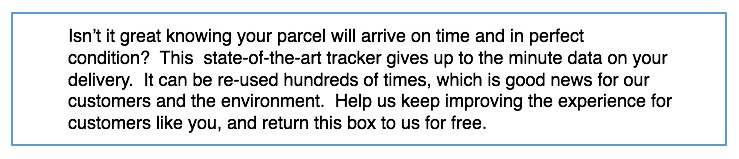
These devices are valuable, so it is tempting to do so. The “Deterrence Hypothesis” suggests that a fine would work. However, it can backfire in several ways. Consumers may comply to avoid a penalty, or avoid a brand that threatens penalties. Then there is our sense of fairness (Justice Theory), and our need to have a level of control over the penalty situation. If we know how we can avoid the penalty, have the appropriate warning, and the amount seems to reflect the action, we are more accepting (17). There is, however, a risk that a fine becomes a price, as illustrated by the tests done with parents picking up their kids from daycare. The number of parents being late, and the amount of time by which they were late, increased with the implementation of the fine system. Indeed, even after the fine was removed, the behaviour remained. Framing is key, so we have embraced that sense of a “price” directly, framing the penalty as something they can opt to pay to keep the unit (18). It is unlikely that most will, but, as with Love Film’s freezing of accounts if DVDs weren’t returned, it’s a win-win situation either way.
Will These Cues Work To Normalise A Behaviour That Doesn’t Exist Yet?
It will be an iterative process, as we learn which combination is most effective, and as people learn what the tracker is for. We will continue to test and learn, taking into consideration your branding, cultural differences with your customers and son on. Our design nudges will be even more effective in partnership with you. From sharing data with your customers to making donations to your chosen charity for every unit returned, there are plenty of incentives we can offer that will crystalise the benefit of using Parcelive.
References:
(1) Ambady, N., & Rosenthal, R. (1992). Thin slices of expressive behavior as predictors of interpersonal consequences: A meta-analysis. Psychological Bulletin, 111, 2, 256-274.
(2) Clement J. (2007) Visual influence on in-store buying decisions: an eye-track experiment on the visual influence of packaging design. Journal of Marketing Management 2007; 23(9–10): 917–928.
(3) Dodds, W. B. (1995). Market Cues Affect on Consumers’ Product Evaluations. Journal of Marketing Theory and Practice, 3, 2, 50-63
(4) Vanhuele, M, & Drèze , X; (2002) Measuring the Price Knowledge Shoppers Bring to the Store. Journal of Marketing: October 2002, Vol. 66, No. 4, pp. 72-85.
(5) Olson, J & Jacoby, J; (1972) Cue Utilization in the Quality Perception Process in SV – Proceedings of the Third Annual Conference of the Association for Consumer Research, eds. M. Venkatesan, Chicago, IL : Association for Consumer Research, Pages: 167-179.
(6) Norton, D & Stark, L, (1971) Scanpaths in eye movements during pattern perception, Science. 1971 Jan 22;171(3968):308-11.
(7) Nielsen J. (2000), Designing Web Usability, Indianapolis, Indiana, New Riders Publishers
(8) Kauppinen-Räisänen, H. (2014). Strategic Use of Colour in Brand Packaging. Packaging Technology and Science, 27, 8, 663-676.
(9)Adams, F.M. & Osgood, C.E. (1973) A Cross-Cultural Study of the Affective Meanings of Colour, Journal of Cross Cultural Psychology 4(2): 135–56.
(10) Moe, W.W.& Fader P.S., (2004), Dynamic Conversion Behaviour at E-Commerce Sites Management Science, 50 (3), 326-35.
(11) Von Restorff, H. (1933). Über die Wirkung von Bereichsbildungen im Spurenfeld (The effects of field formation in the trace field) Psychological Research 18 (1): 299–342.
(12) Sirgy, J; Rahtz, D; & Portolese Dias, L; (2014). Consumer Behavior Today. Irvington, NY: Flatworld Knowledge Publishers
(13) Tajfel, H & Turner, J (1978) The Social Identity Theory of Intergroup Behaviour
(14) Ariely, D., Kamenica, E., & Prelec, D. (2008). Man’s search for meaning: The case of Legos. Journal of Economic Behavior and Organization, 67, 3, 671-677.
(15) Zaltman G & Coulter RH (1995) Seeing the voice of the customer: Metaphor-based advertising research. Journal of Advertising Research 1995; 35(4): 35–51
(16) Lawes, R. (2002), Demystifying Semiotics: Some Key Questions Answered, International Journal of Market Research, 44, 3, 262–64
(17) Michael, S. M. C., & Eugene, H. F. (2000). An exploratory investigation of customer penalties: assessment of efficacy, consequences, and fairness perceptions. Journal of Services Marketing, 14, 6, 479-501.
(18) Gneezy, U., & Rustichini, A. (1999). A Fine Is a Price. Journal of Legal Studies Chicago-, 29, 1-18.