






Container fleets lose visibility mid-ocean when battery trackers die, and operations teams end up finding out about delays days too late. Solar GPS units charge off ambient light, run for a decade or more, and feed continuous location data into the platforms your team already uses. The result is a shipment tracking solution that stops surprising you at the port.
Key Takeaways
- Battery trackers fail mid-ocean and leave you blind for the most expensive leg of the journey, while solar units charge off ambient light and keep reporting for ten years or more.
- A tracker is only as useful as the stack behind it, so the 5G network, cloud platform, alerts engine, and API integrations matter as much as the hardware itself.
- Solar GPS suits container fleets because pings once or twice an hour give you location, dwell time, and geofence breaches without the cost of disposable devices.
- Before you commit, check the casing for marine conditions, the warranted lifespan, integration with your TMS or ERP, and how the platform handles long stack-buried gaps.
A 40-foot container can sit at a port for two weeks before anyone in operations even notices. The shipping line might know. The terminal definitely knows. The people paying for the cargo often do not. That gap between what is happening and what gets reported is where most of the pain lives. A shipment tracking solution built around a constant signal exists to close that gap. Not perfectly. But close enough that you stop being the last person to find out things have gone sideways. The hardware doing this work is solar GPS, small units that bolt onto the container and run off ambient light.
Why solar earns its place on a container
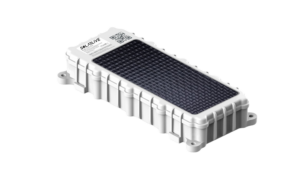
Containers are awkward assets. They move slowly. They sit in yards for days. They cross oceans where you cannot exactly send someone out to swap a battery. Older battery-powered trackers ran out of juice somewhere mid-Pacific, and that was the end of your visibility for that leg. You only found out at the port, when the box finally arrived and someone scanned it back into a system. By then the trip was over and the data was of little use to anyone. A solar powered tracking device for logistics works on a different principle. It tops itself up whenever it sees light, so the mid-ocean blackout stops being a fact of life.
Solar fixes that, more or less. The unit charges itself off ambient light, even on grey days. There is a small backup cell for hold time and tunnel runs. Lifespan stretches past ten years on properly built hardware. Once you bolt one on, you can mostly forget about it for a long time.
The cost picture changes, too. Disposable trackers add up fast across a fleet of a few thousand boxes. Solar units, in theory, pay themselves back somewhere around year two or three. Numbers depend on your routes, but the direction of travel is fairly consistent.
What sits behind the device
The tracker itself is only the front end. A real shipment tracking solution has three or four layers stacked behind it, and the value comes from how they talk to each other.
- A 5G IoT network with global roaming, so the device keeps reporting wherever it ends up
- A cloud platform that ingests pings, time-stamps them, and runs them against your geofences and rules.
- An alerts engine for breaches, idle time, and movement outside business hours
- An API that pushes the data straight into your TMS, ERP, or whatever else your team actually lives in
Miss any one of these, and the rest get half as useful. A device that pings beautifully to a portal nobody logs into is, basically, a paperweight.
What the data actually shows you
Solar GPS for containers is built around the asset itself, not the cargo inside. Pings are less frequent than a parcel-level tracker. Once or twice an hour is plenty for sea legs, with extra fixes when the box hits a port boundary or starts moving after a long pause.
The picture you get is something like this:
- Where every container in your fleet is, right now
- How long each one has been sitting since its last move
- Which boxes have crossed which geofences this week
- Where the hotspots are showing up in your network
Worth thinking about before you commit
A few questions to put on the table:
- Does the casing handle marine spray, sub-zero nights, and 50-degree decks
- What is the warranted lifespan, in years
- Does the platform integrate with what your team already uses?
- What happens to the data when the container is buried in a stack for a week
Solar is not a fit for fast-moving parcel work. For container fleets, though, it solves a problem that batteries quietly never solved.
Featured image source: https://media.istockphoto.com/id/2198548314/photo/strategic-world-map-of-the-americas-with-digital-infographics-overlay.jpg?b=1&s=612×612&w=0&k=20&c=Sxc_18lI4bZp_suf30dYqRn0Bq3RnCwo2sT_ujR18MY=