












GPS trackers, data loggers and RFID tags are often grouped together as “shipment tracking”, but they answer different questions. A GPS tracker tells you where a shipment is and what is happening to it now. A data logger tells you what happened, once you read it. RFID tells you that a tagged item passed a reader. Choosing the wrong one leaves blind spots exactly where problems happen.
The short answer
- Need to act while goods are moving? Use a real-time GPS tracker with condition sensors.
- Need a record to check on arrival? A data logger does that job.
- Need to count and identify items at fixed points, such as warehouse doors? RFID is built for it.
How a GPS tracker works
A GPS tracker works out its position from satellites and sends it over a mobile network. GPS is one of several satellite systems: Galileo, GPS, GLONASS and BeiDou are all part of GNSS, the umbrella term for satellite positioning. Under open sky a GPS-enabled phone is typically accurate to within about 4.9 metres, and signals weaken indoors and around large buildings.
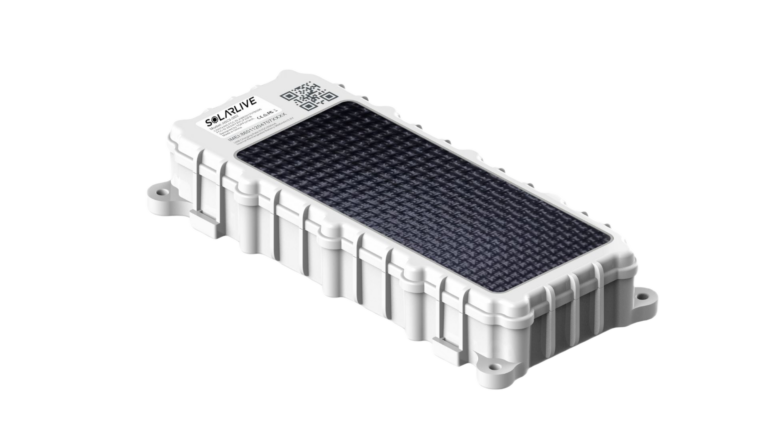
For cargo, the location is only half the story. Trackers with condition sensors also report temperature, humidity, shock, light and tilt, so a door opened in transit or a pallet dropped in a warehouse shows up while there is still time to act. Because these devices depend on mobile networks, IATA notes that network shutdowns, such as the switch-off of 2G and 3G, can shorten a device’s working life, so it is worth asking how a tracker connects.
How a data logger works
The World Health Organization describes a temperature data logger as a small portable device that measures and stores temperature at set intervals. The data is usually downloaded when the shipment arrives, and some loggers need their own software to read it. How long a logger can record depends on its memory.
Loggers are dependable for proving what happened: WHO guidance asks for time and temperature records to be kept for at least three years. Their limit is timing. You usually learn about a temperature excursion after delivery, when the goods may already be lost.
How RFID works
RFID tags are read by radio. Passive tags have no radio transmitter of their own and are powered by the reader; active tags carry a battery and transmitter. According to GS1, passive UHF tags are typically read within several metres, and active tags at 100 metres or more.
RFID shines in warehouses and distribution centres: one handheld reader can count hundreds of items in the time it takes to scan one barcode. Between read points, though, you see nothing, so on its own RFID cannot tell you where a lorry is or whether a container is overheating at sea.
GPS tracker vs data logger vs RFID at a glance
| GPS tracker | Data logger | RFID | |
|---|---|---|---|
| What it tells you | Where the shipment is and its condition, as it happens | What conditions were, once the data is read | That a tagged item passed a reader |
| When you find out | During the journey | Usually after delivery | At each read point |
| Location | Yes, from satellite positioning | No, in most models | Only the location of the reader |
| Condition (temperature, shock, light…) | Yes, with sensors | Yes, recorded | Only on some active or sensor tags |
| Coverage | Anywhere with a mobile network | Anywhere (records throughout) | Within a few metres of a reader (passive tags) |
| Best for | Acting on delays, theft and damage in transit | A record for compliance and claims | Counting and identifying items at fixed points |
Taking trackers on aircraft
Air cargo has extra rules for devices with batteries. Lithium batteries are classed as dangerous goods and must pass the UN 38.3 tests. Active trackers and data loggers can travel outside the dangerous goods rules when they meet set conditions, including battery limits of 20 Wh for lithium-ion or 1 g of lithium metal, and standards that stop the device interfering with aircraft systems.
The final say rests with the airline. IATA guidance says each operator approves the devices it carries, and using unauthorised or undeclared tracking devices may result in cargo being held, delayed or returned. In the United States, FAA guidance sets the radio-emission tests a transmitting device must pass, or requires two independent ways to switch it off. Before you ship by air, check that your tracker is approved by every carrier on the route.
ParceLive is approved by IATA and more than 40 airlines. See the full list on our airline approvals page.
Reusable or single-use?
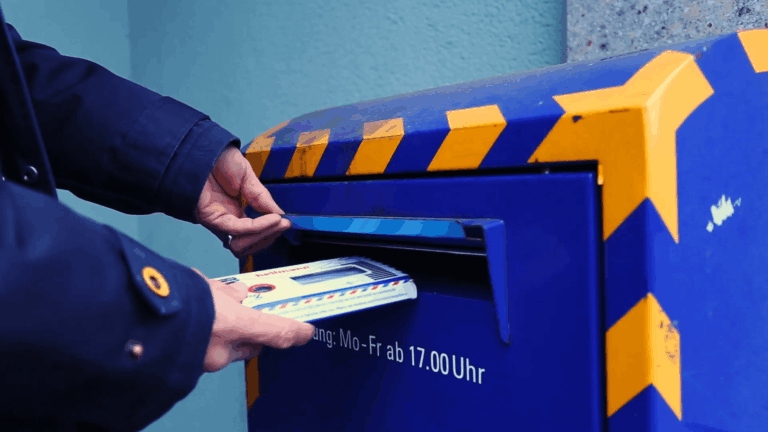
Many trackers and loggers are used once and thrown away. IATA lists the drawbacks of single-use devices as “non-reusable” and generating “non-recyclable e-waste”. Reusable devices avoid that, but only if someone gets them back, charges them and sends them out again. With ParceLive, Hanhaa does that part: trackers come back to us at no extra cost and are recharged for their next journey.
Which should you choose?
- Pharmaceutical and cold chain: real-time monitoring lets you step in before an excursion ruins a shipment. IATA’s CEIV Pharma programme reported in 2015 that more than half of temperature excursions happen while products are with airlines and at airports. Many teams pair a real-time tracker with the record their quality process requires.
- High-value goods: a tracker that reports light (a box being opened), shock and location lets you respond to theft or mishandling as it happens.
- Warehouses and inventory: RFID is the efficient way to count and identify large numbers of items at fixed points.
- Multimodal journeys: a single tracker that travels inside the cargo across air, sea and road gives one view of the whole journey, whichever carrier is moving it.
Where ParceLive fits
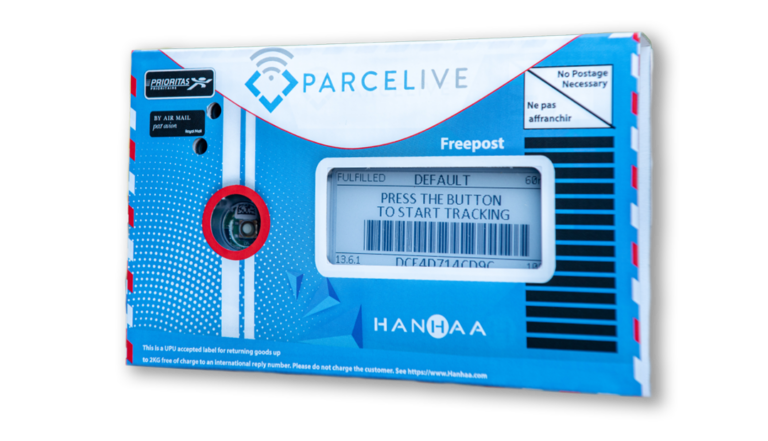
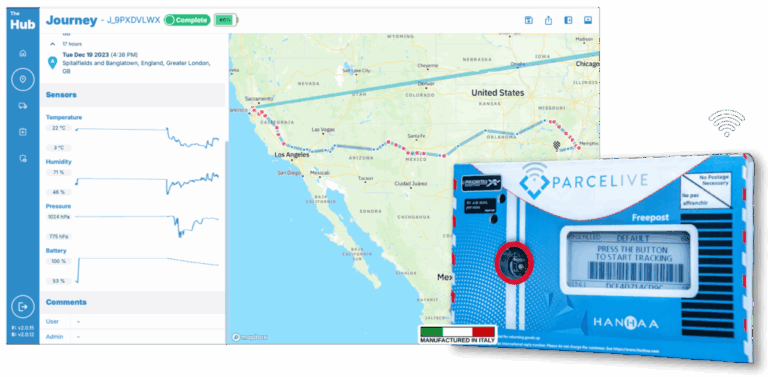
ParceLive travels inside the shipment and reports location, temperature, humidity, shock, freefall, light and tilt in real time. The Hub shows every tracker on a live map, sends alerts when your limits are crossed, and lets you download the data, share a journey with a link or send it into your own systems through our API. Our customers ship worldwide, and every tracker is reused. Hanhaa has offices in London, at Pennine Place, 2A Charing Cross Road, London WC2H 0HF, and in Porto, Portugal, at UPTEC Asprela 1, Rua Alfredo Allen 455, 4200-135 Porto.
Want to see it on your own shipments? Request a trial or contact us.
Sources
- EUSPA: What is GNSS?
- GPS.gov: GPS accuracy (archived page)
- IATA: Towards sustainable management for IoT cargo devices (2024)
- WHO Technical Report Series 961, Annex 9, Supplement 15 (2015)
- GS1: Passive and active RFID tags
- GS1: Typical RFID read ranges
- GS1: Benefits of RAIN RFID
- IATA: Lithium Battery Guidance Document, revised for the 2026 regulations
- IATA: Standard operating procedure for IoT cargo device handling
- FAA Advisory Circular 91.21-1D (2017)
- IATA CEIV Pharma infographic (2015)
Frequently asked questions
Is a GPS tracker better than a data logger?
They answer different questions. A GPS tracker with condition sensors tells you where a shipment is and what is happening to it while it is moving, so you can act. A data logger records conditions for you to review after delivery, which is useful as a record. Many shippers use real-time tracking for in-transit action and keep loggers where their quality process requires them.
Can RFID track a shipment while it is in transit?
Only where readers are installed. Passive RFID tags have no radio transmitter of their own and are read within a few metres of a reader, so you see a shipment when it passes a dock door or gateway, not between those points.
Can I put a GPS tracker in air cargo?
Yes, if the device meets the rules and the airline has approved it. Active trackers must meet battery and electromagnetic limits, and each airline approves the devices it accepts. Unapproved devices can lead to cargo being held, delayed or returned. ParceLive is approved by IATA and more than 40 airlines.
Do I still need a data logger if I use a real-time tracker?
It depends on your quality requirements. A real-time tracker such as ParceLive stores its readings and lets you download the data, but some regulated processes specify a particular qualified logger. Check what your quality team needs; using both is common.
Have a question?
Ask us about any of our products and services, or try ParceLive on your own shipments.